SentinelSecure
An AI/ML-based network intrusion detection and triage system developed for RΞDACT 2025.
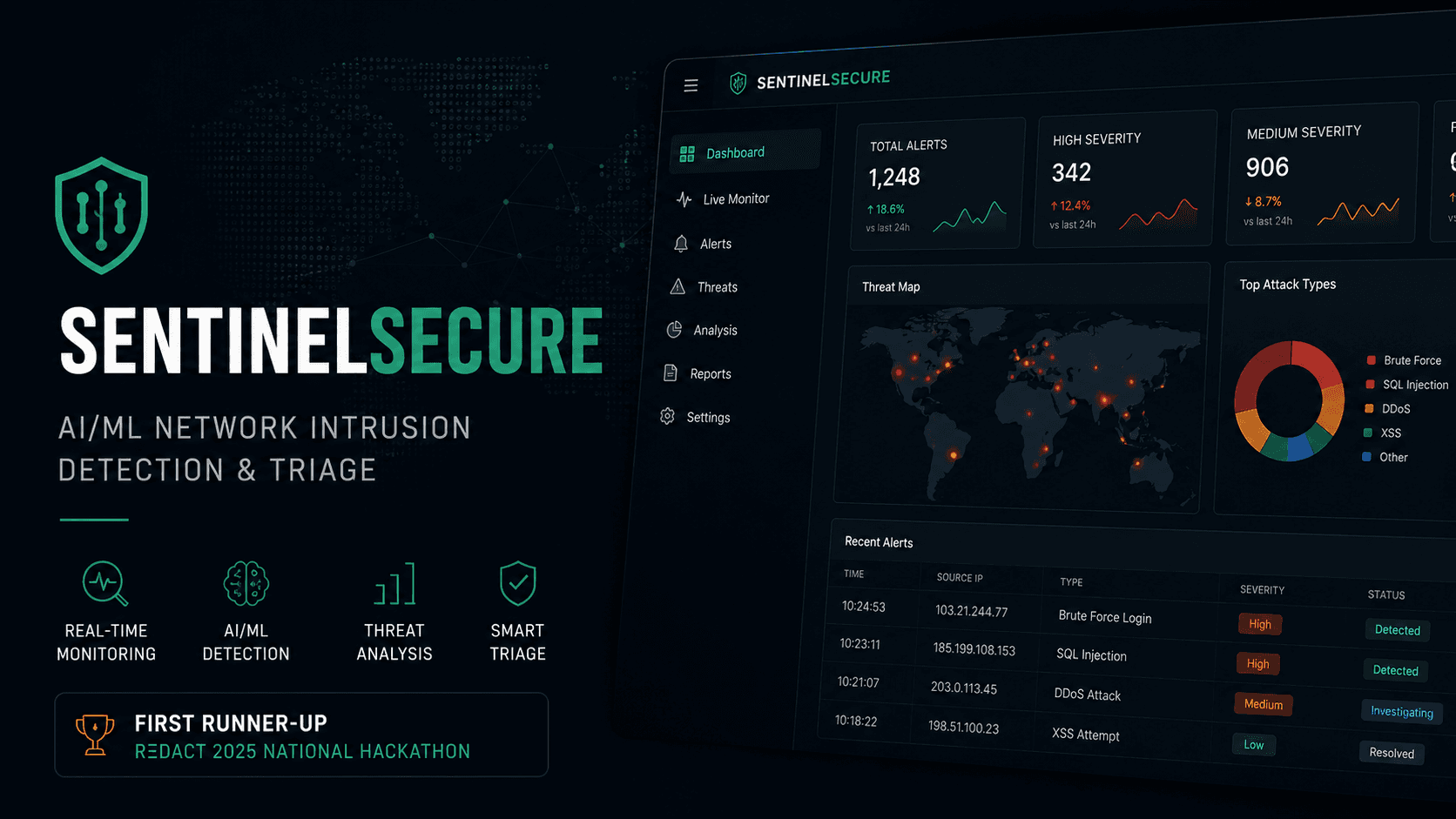 SentinelSecure / supplied media
Start with the reason to build.
Security teams need a way to detect suspicious network behavior and move from a signal to an understandable triage decision.
What shaped the work.
SentinelSecure was developed as a competitive project for RΞDACT 2025, where the team explored an applied security workflow around intrusion detection.
A system, not a feature demo.
The team combined machine-learning detection, threat analysis and explainability into a workflow that makes a security signal easier to inspect. The Streamlit dashboard gives that system a usable surface for exploration and triage.
Be precise about ownership.
I personally built the Streamlit dashboard and handled the system/workflow integration. The wider team/system included ML detection, XGBoost, threat analysis and SHAP explainability.
The parts that made it real.
- Python-based ML workflow with XGBoost
- SHAP explainability for model reasoning
- Streamlit dashboard for inspection and triage
- Integration of detection and analysis workflow
Architecture is represented here as a focused system sketch: the important interfaces and decisions are more useful than a decorative diagram.
Where engineering judgment mattered.
- Connecting model output to a usable investigation surface
- Making detection results understandable rather than opaque
- Keeping ownership boundaries clear across the team-built system
Every system carries a choice.
Streamlit was chosen for the dashboard because the project needed a fast, focused interface around the model workflow. It kept iteration close to the Python system without introducing a separate frontend stack.
First Runner-Up nationally at RΞDACT 2025.
- Explainability is part of a useful ML system, not an afterthought.
- A model becomes more valuable when the surrounding workflow supports a real decision.
- Integration work requires as much clarity as individual components.